The Physics Behind High-Pressure Hose Nozzles, Explained Simply
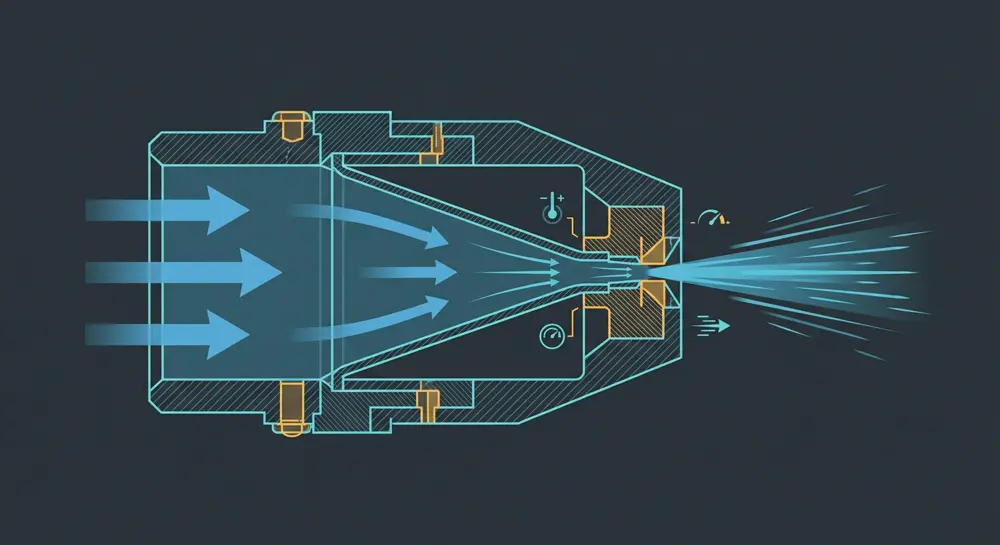
It sounds like a contradiction: a small metal attachment with no motor and no battery that sprays noticeably harder than the hose it's screwed onto. There's no trick to it, though — it's the same bit of fluid dynamics that shows up in carburetors, perfume atomizers, and the narrow end of a river. It's called the Venturi effect, and once you see the shape of the chamber, the rest follows naturally.
Same amount of water, less room to move
Water flowing through a hose at a given rate has to keep moving through any nozzle attached to the end, no matter how narrow that nozzle gets — that's simple conservation of mass. If the water is going to keep flowing at the same volume per second through a smaller opening, it has only one option: it has to speed up. Squeeze the same volume of water through a chamber that narrows partway down, and the water exits that narrow point moving considerably faster than it entered.
Where the extra force actually comes from
Force on a surface — the driveway, the car panel, the algae film — comes from momentum transfer: mass times velocity. The nozzle isn't adding new water or new energy from nowhere. It's converting the same water's pressure energy into velocity as it funnels through the narrowing chamber, so what lands on the surface hits with more speed and, therefore, more force than it would as a wide, slow stream straight from the hose.
Why the tip matters as much as the taper
A narrowing chamber alone would spray a fine, weak mist if the exit weren't tuned. That's what the brass tip is doing on a well-built nozzle: it holds the final opening at a diameter that keeps the stream coherent — a tight column of fast water rather than an atomized cloud that loses force within a foot or two of the tip. Get the taper and the tip diameter wrong and you either lose the pressure gain to a fine mist, or you get pressure with no usable spray pattern at all.
Why this needs no power source
- The energy already exists in your home water supply, which is pressurized to push water up through pipes and out of every faucet in the house.
- A pump-driven pressure washer adds energy with a motor; a Venturi nozzle simply redirects existing energy more efficiently.
- That is also why the ceiling is lower than a plug-in pressure washer — you are reshaping existing pressure, not generating new pressure from scratch.
None of this is exotic engineering — it is the same principle taught in a first-semester fluid dynamics course. What makes a hose nozzle actually work well in practice is getting the taper angle, chamber length, and tip opening tuned so the pressure gain survives all the way to the surface you are cleaning, which is the specific engineering the JetStrike Water Hose is built around.
Ready to see it for yourself?
Get the JetStrike Water Hose and put the Venturi boost to work on your own driveway, patio, or car.