5 Outdoor Cleaning Jobs a Garden Hose Alone Can't Handle
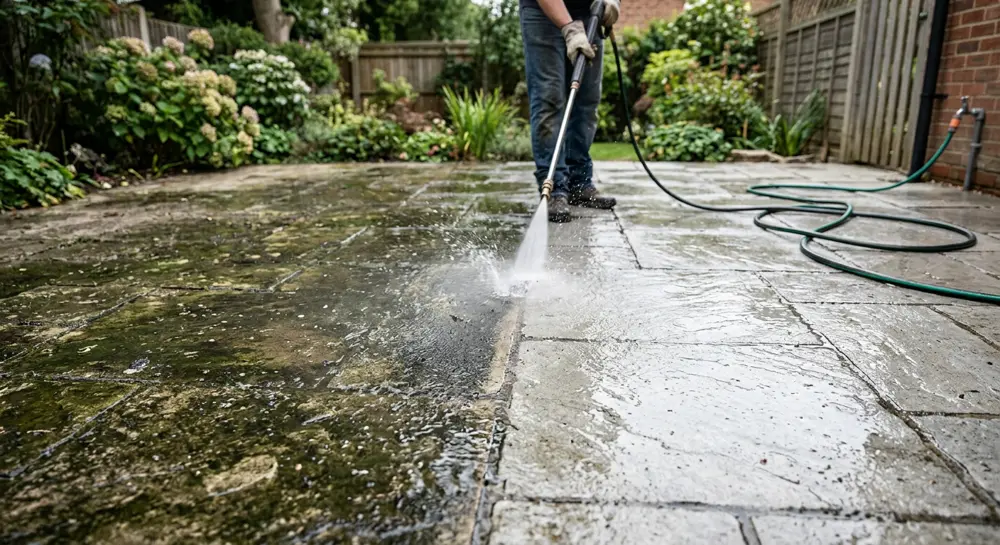
Turn on an ordinary hose and you get a wide, soft stream that's perfect for filling a bucket or soaking a flower bed. Point that same stream at a season's worth of driveway grime and nothing happens except a wet driveway. The water simply doesn't carry enough force to break the bond between dirt and concrete. Below are five jobs where that gap shows up every single year, and what it actually takes to close it.
1. Driveway and walkway stains
Oil drips, tire marks, and general grime bake into concrete under the sun until they're practically part of the surface. A standard hose stream skates across the top of these stains without lifting anything. It takes a genuinely concentrated jet — not just more water, but faster water — to physically knock the bonded grime loose instead of just wetting it.
2. Algae and mildew on patio stone
Shaded stone and pavers stay damp longer, which is exactly what algae and mildew need to take hold. That green film is slick, thin, and stubbornly attached — soft water pressure just slides over it. A tighter, faster stream shears the film away at the surface instead of pushing water through it.
3. Caked mud on tires, wheel wells, and truck beds
Mud that has dried onto a wheel well or truck bed liner behaves more like a shell than a stain. Soaking it with a low-pressure hose eventually softens the outer layer, but it can take fifteen minutes of standing there to get anywhere. A concentrated jet breaks through the crust in the first few seconds and lets the rest wash away normally.
4. Gunked-up outdoor furniture and grills
Pollen, grease splatter, and general weather grime build up in the grooves of patio furniture and the outside of a grill in a way that a rag can't reach and a soft stream can't dislodge. Getting into those seams needs a narrow, forceful jet that can be aimed precisely, not a wide spray that mostly just wets the surrounding patio.
5. Gutters and siding grime out of easy reach
Anything above head height turns into a ladder problem with a normal hose, because the stream loses most of its force by the time it reaches the second story. A tighter jet holds its shape and force over distance, so siding grime and gutter debris come off from ground level instead of requiring a climb.
The common thread in all five is the same: it was never really about water volume, it was about how concentrated and fast that water arrives. That's the specific gap the JetStrike Water Hose is built to close — it threads onto the hose you already own and turns the same water pressure into a tighter, faster stream, with nothing to charge and nothing to plug in.
Ready to see it for yourself?
Get the JetStrike Water Hose and put the Venturi boost to work on your own driveway, patio, or car.